
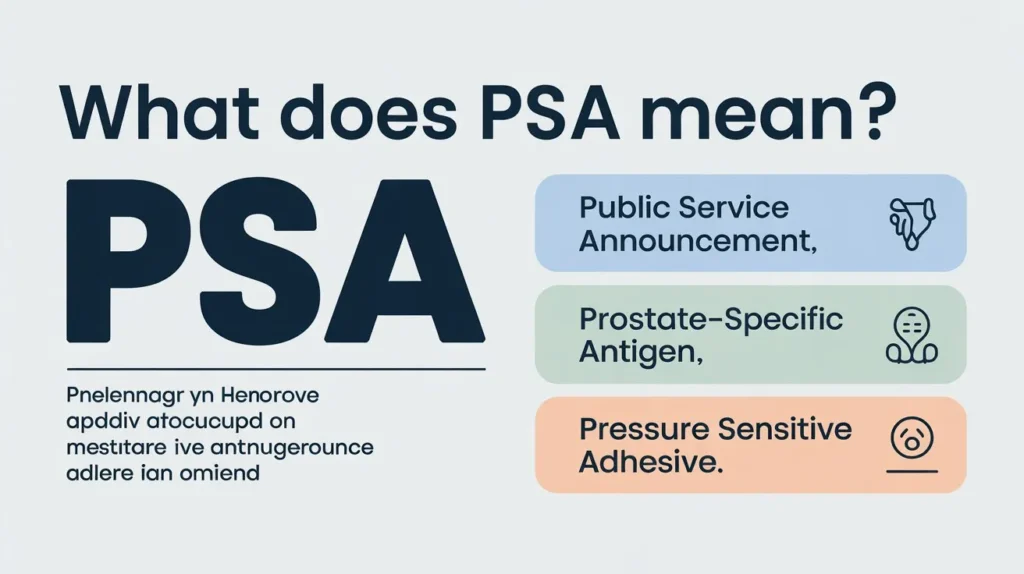
If you’ve come across the term PSA and wondered what it actually means, you’re not alone. PSA is a common abbreviation, but its meaning can change completely depending on where and how it’s used.
In some contexts, PSA refers to an important medical term related to men’s health. In others, it stands for a public service announcement used to spread awareness.
You may also see PSA used casually in text messages or social media to highlight an important message or warning. Because of these different uses, PSA can be confusing for many readers.
This article explains what does PSA mean in clear, simple language. We’ll break down every major definition of PSA, explain how it’s used in real life, and help you understand which meaning applies in different situations.
By the end, you’ll have a complete understanding of PSA no matter where you see it used.
What Does PSA Stand For? (Full Form Explained)
The abbreviation PSA stands for different phrases depending on the context in which it is used. Unlike acronyms with only one definition, PSA is a multi-purpose term that appears in healthcare, media, online communication, business, and even collectibles. Understanding what PSA stands for requires looking at where the term is being used and who is using it.
The two most widely recognized full forms of PSA are Prostate-Specific Antigen and Public Service Announcement. In medical settings, PSA refers to a protein produced by the prostate gland that is measured through a blood test to help assess prostate health. In contrast, in media and public communication, PSA stands for Public Service Announcement, which is a message created to inform or educate the public about important social, safety, or health issues.
Outside of these formal uses, PSA has also become popular in texting and social media slang. In this context, PSA is often used to introduce an important notice or reminder, similar to saying “just a heads up.” Additionally, PSA can represent organizations or services in niche fields, such as Professional Sports Authenticator in the collectibles and card grading industry.
Because PSA can stand for several different things, context is essential. The surrounding words, platform, and topic usually make it clear which PSA meaning applies. Understanding this flexibility is the first step to using and interpreting the term correctly.
PSA Meaning in Medical Terms
In medical and healthcare contexts, PSA stands for Prostate-Specific Antigen. It is a protein produced by both normal and abnormal cells in the prostate gland, which is found only in men. PSA is mainly present in semen, but a small amount also circulates in the bloodstream. Doctors measure PSA levels through a simple blood test to help evaluate prostate health.
A PSA test is commonly used as a screening tool for prostate-related conditions. While elevated PSA levels can be associated with prostate cancer, they do not automatically mean cancer is present. PSA levels can rise due to several non-cancerous reasons, including an enlarged prostate (benign prostatic hyperplasia), prostate inflammation (prostatitis), urinary tract infections, or even recent physical activity affecting the prostate.
PSA levels are usually measured in nanograms per milliliter (ng/mL). What is considered a “normal” PSA level can vary based on age, medical history, and individual risk factors. In general, lower PSA levels are preferred, but doctors often look at changes over time rather than a single test result. A rapid increase in PSA may be more concerning than a slightly elevated but stable level.
It’s important to understand that the PSA test has limitations. It can produce false positives and may lead to additional testing that isn’t always necessary. For this reason, healthcare professionals consider PSA results alongside symptoms, physical exams, and other diagnostic tools. Anyone with concerns about PSA levels should consult a qualified medical professional for personalized advice.
PSA Meaning as a Public Service Announcement
Outside of healthcare, PSA most commonly stands for Public Service Announcement. A public service announcement is a message created to inform, educate, or influence the public about important issues that affect society. Unlike commercial advertisements, PSAs are not designed to sell products or services. Instead, their goal is to raise awareness and encourage positive behavior.
Public service announcements are often produced by government agencies, nonprofit organizations, schools, and community groups. Common PSA topics include public health, road safety, environmental protection, emergency preparedness, and social responsibility. For example, anti-smoking campaigns, seatbelt reminders, and mental health awareness messages are all well-known forms of PSAs.
Traditionally, PSAs were shared through television and radio, often aired during free or discounted time slots. Today, they are widely distributed through social media platforms, websites, streaming services, and digital ads, allowing them to reach a much larger and more targeted audience. Short videos, infographics, and shareable posts are especially popular formats for modern PSAs.
The effectiveness of a PSA depends on clear messaging, emotional connection, and relevance to the audience. A strong public service announcement delivers a simple message, explains why the issue matters, and motivates people to take action whether that means changing a habit, staying informed, or helping others. When you see “PSA” used in a public or media-related context, it almost always refers to this type of awareness-focused announcement.
PSA Meaning in Text, Social Media, and Slang
In texting, online conversations, and social media platforms, PSA is commonly used as informal slang. In this context, PSA usually means “public service announcement,” but the tone is much more casual and conversational. Instead of referring to an official campaign, people use PSA to introduce an important message, reminder, or warning they want others to notice.
For example, someone might write, “PSA: The meeting time has changed,” or “PSA: This app update will delete your old data.” In these cases, PSA is used to grab attention and signal that the information that follows is important. It functions similarly to phrases like “heads up,” “important notice,” or “just so you know.”
On social media platforms such as X (formerly Twitter), Instagram, TikTok, and Facebook, PSA is often placed at the beginning of a post or caption. Creators and users use it to highlight advice, corrections, safety tips, or trending updates. The message may be serious, humorous, or slightly exaggerated, depending on the context and audience. This flexibility has helped PSA become a popular shorthand online.
Although PSA slang is derived from the formal term “public service announcement,” it does not always involve public benefit. Sometimes it is used for personal opinions, jokes, or minor updates. Because of this, understanding the tone and platform is key. When PSA appears in casual digital communication, it generally signals emphasis rather than an official announcement, helping readers quickly recognize the importance of the message.
PSA Meaning in Business and Professional Use
In business and professional environments, PSA is often used as a shorthand for Public Service Announcement, but its meaning and tone differ from casual or social media usage. In this context, a PSA typically refers to an important informational message shared with employees, customers, or the general public. The goal is to communicate timely updates rather than promote a product or service.
Companies may issue PSAs to address topics such as policy changes, safety guidelines, system outages, data security notices, or workplace conduct. For example, an internal email labeled as a PSA might inform staff about new compliance rules or upcoming maintenance that could affect operations. Because PSAs are meant to inform rather than persuade, they are usually written in a clear, direct, and professional tone.
In some industries, especially marketing and communications, businesses also create PSAs as part of their corporate social responsibility (CSR) efforts. These messages support social causes like environmental sustainability, public health awareness, or community safety. Although the organization’s name may appear, the focus remains on education and awareness, not branding or sales.
It’s important to distinguish a PSA from other business communications such as press releases or advertisements. A press release is designed to attract media attention, while an advertisement promotes a specific offering. A PSA, on the other hand, delivers useful information for public or internal benefit. When PSA is used in a professional setting, it usually signals that the message is informational, time-sensitive, and relevant to a broad audience rather than promotional in nature.
PSA Meaning in Sports, Collectibles, and Grading
In the world of sports memorabilia and collectibles, PSA has a completely different meaning. Here, PSA stands for Professional Sports Authenticator, a well-known company that specializes in authenticating and grading collectible items, especially sports cards. This use of PSA is common among collectors, investors, and hobbyists.
PSA evaluates items such as baseball cards, basketball cards, Pokémon cards, and other trading cards to verify their authenticity and assess their condition. After inspection, the item is given a PSA grade, typically on a scale from 1 to 10, with 10 representing a gem-mint condition. The graded item is then sealed in a protective case, often called a “slab,” with a label displaying the PSA grade and certification number.
A PSA grade can significantly impact the value and credibility of a collectible. Higher-graded cards are usually more valuable because they are rarer and have been professionally verified. Collectors trust PSA because of its strict grading standards and long-standing reputation in the industry. As a result, PSA-certified items are often easier to sell and command higher prices in the resale market.
When PSA is mentioned in discussions about card values, auctions, or investments, it almost always refers to Professional Sports Authenticator. This meaning is very specific and easy to identify due to the surrounding context. Understanding this definition is important for anyone involved in collecting, trading, or investing in sports and trading cards.
Other Less Common Meanings of PSA
Beyond its most popular definitions, PSA can also have several less common meanings depending on the field or industry. These uses are more specialized, but they can still appear in academic, technical, or professional contexts, which is why they’re worth understanding.
In education, PSA may refer to a Parent–School Association or similar organizations focused on improving communication between parents and educational institutions. These groups often support school activities, fundraising, and student development. In this context, PSA is typically mentioned in school newsletters, meeting notices, or community announcements.
In government and administration, PSA can sometimes stand for Public Sector Accounting or be used as an internal abbreviation within specific departments. These meanings are not universal and usually depend on regional or organizational terminology. The surrounding language often makes the intended definition clear.
In technology or engineering, PSA may appear as a technical acronym with meanings unique to a specific system, process, or software. For example, it could be used internally to describe a tool, protocol, or alert system. These definitions are usually limited to professional or internal documentation rather than general public use.
Because these meanings are niche, they are less likely to appear in everyday searches. However, if you encounter PSA in a document that doesn’t seem to match medical, media, or slang usage, it’s best to look at the industry, audience, and purpose of the content. Context remains the key factor in identifying the correct meaning and avoiding misunderstandings.
How to Tell Which PSA Meaning Is Being Used
Because PSA has multiple meanings, identifying the correct one depends entirely on context. The same three letters can refer to a medical test, an announcement, or a grading service, so paying attention to clues in the surrounding content is essential.
Start by looking at the topic or industry being discussed. If the content mentions health, blood reminders, doctors, or test results, PSA almost certainly refers to Prostate-Specific Antigen. Words like “levels,” “screening,” or “blood test” are strong indicators of the medical meaning. On the other hand, if the message appears in a video, post, or campaign encouraging awareness or behavior change, PSA most likely means Public Service Announcement.
Next, consider the platform and tone. In casual settings such as text messages, social media posts, or online forums, PSA is usually used as slang to introduce an important note. These messages often start with “PSA:” and are written informally. In professional or corporate environments, PSA often signals an informational update meant for a broad audience, such as a safety notice or policy reminder.
Finally, look for specific identifiers. References to grading scales, authentication, card condition, or resale value point clearly to Professional Sports Authenticator. Niche industries may use PSA in unique ways, but these are usually explained within the document.
By analyzing the subject, setting, and language, you can quickly determine which PSA meaning applies and avoid confusion when encountering the term.
Common Misconceptions About PSA
Despite being widely used, PSA is often misunderstood because people assume it has only one definition. One of the most common misconceptions is that PSA always refers to prostate cancer. While PSA is a medical term related to prostate health, elevated PSA levels do not automatically mean cancer. Many non-cancerous conditions can cause PSA levels to rise, and doctors interpret results alongside other tests and symptoms.
Another misconception is that PSA only applies to healthcare. In reality, PSA is frequently used outside medicine, especially as Public Service Announcement. Many people encounter PSAs daily through social media, television, or public campaigns without realizing the term has a medical meaning as well. Assuming a single definition can lead to confusion when reading or hearing the term in different contexts.
Some also believe that PSAs are always official or government-issued messages. While many public service announcements are created by government agencies or nonprofits, individuals and businesses now use “PSA” informally online to draw attention to important points. This slang usage does not carry the same authority as formal PSAs, even though it uses the same term.
Finally, collectors sometimes assume all graded cards are PSA-certified. PSA is one of the most respected grading companies, but it is not the only one. Understanding these misconceptions helps clarify what PSA actually means in different situations and prevents incorrect assumptions when encountering the term in everyday communication.
Frequently Asked Questions
What does PSA mean in simple terms?
PSA is an abbreviation with multiple meanings. Most commonly, it stands for Prostate-Specific Antigen in medical contexts and Public Service Announcement in media and everyday communication. The correct meaning depends on how and where the term is used.
What does PSA stand for in medical terms?
In healthcare, PSA means Prostate-Specific Antigen, a protein produced by the prostate gland. It is measured through a blood test to help doctors assess prostate health and identify potential issues.
What does PSA mean on social media or in text messages?
On social media and in texting, PSA is informal slang used to introduce an important message, reminder, or warning. It’s similar to saying “heads up” or “important notice.”
Is PSA always related to cancer?
No. While PSA testing is associated with prostate cancer screening, high PSA levels do not automatically mean cancer. Other conditions, such as infections or an enlarged prostate, can also raise PSA levels.
What is a PSA announcement?
A PSA announcement refers to a Public Service Announcement, which is a message designed to inform or educate the public about health, safety, or social issues rather than promote a product.
Can PSA have more than one meaning at the same time?
No, but it can have different meanings in different contexts. Looking at the topic, platform, and surrounding words will usually make the intended meaning clear.
These FAQs address the most common questions people have when searching for “what does PSA mean” and help clear up confusion quickly and effectively.
Final Summary:
The term PSA may look simple, but it carries multiple meanings that vary widely depending on context. Understanding what PSA means requires paying attention to where the term is used and what subject is being discussed. Without context, PSA can easily be misunderstood, which is why clarity is so important.
In medical and healthcare settings, PSA stands for Prostate-Specific Antigen, a protein measured through a blood test to help evaluate prostate health. This meaning is most common in discussions about screening, test results, and men’s health. Elevated PSA levels can indicate several conditions, not just cancer, making professional medical interpretation essential.
In public communication, PSA most often means Public Service Announcement. These messages are designed to educate, inform, or encourage positive behavior on issues such as health, safety, and social responsibility. PSAs appear on television, radio, websites, and social media, and they play a key role in spreading awareness.
In casual digital communication, PSA has evolved into slang used to introduce important messages or reminders. Meanwhile, in the collectibles world, PSA refers to Professional Sports Authenticator, a trusted grading and authentication service that significantly impacts the value of trading cards.
Ultimately, PSA is a context-driven abbreviation. By considering the platform, tone, and subject matter, you can quickly identify the correct meaning and confidently understand how PSA is being used in any situation.