
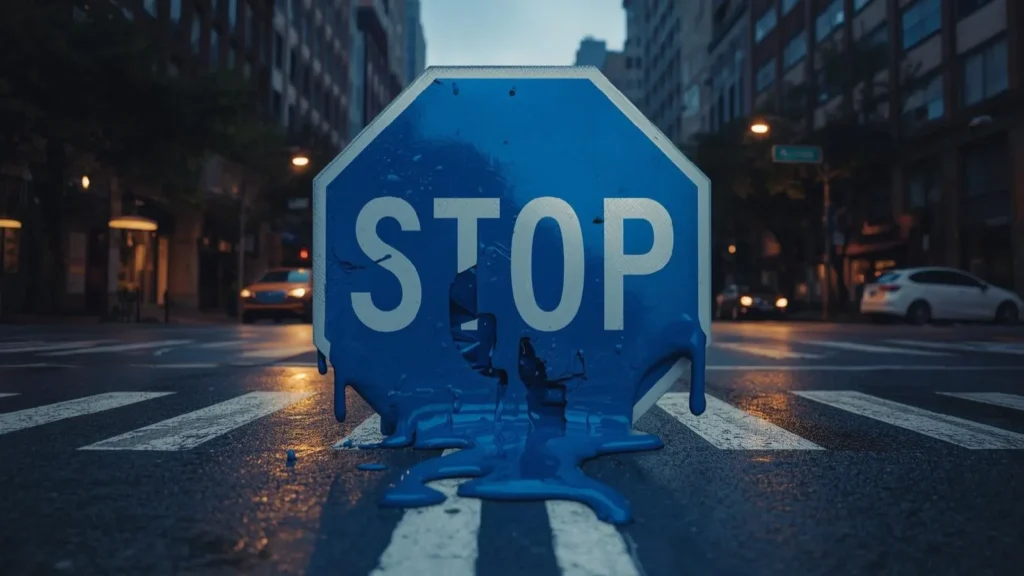
Seeing a blue stop sign on the road can be confusing, especially since most drivers are taught that stop signs are always red. You might wonder whether it’s a real traffic sign, if it carries legal authority, or if you’re required to stop at all.
This question has become increasingly common due to viral images on social media, private property signage, and unusual road layouts that challenge what drivers expect to see.
Understanding the meaning behind traffic sign colors is important not just for legal reasons, but also for safety. In this article, we’ll clearly explain what a blue stop sign means, whether it’s officially recognized, and why it may appear in certain locations.
We’ll also cover the legal implications, common myths, and what drivers should do when encountering one.
By the end, you’ll have a clear, practical answer and the confidence to respond correctly if you ever see a blue stop sign in real life.
What Is a Standard Stop Sign?
A standard stop sign is one of the most recognizable and important traffic control devices in the world. Its purpose is simple but critical: to require drivers to come to a complete stop and yield the right of way before proceeding. Stop signs are used at intersections, crossings, and other locations where traffic conflicts could lead to accidents if not properly controlled.
One key feature of a standard stop sign is its red color with white lettering. This design is not random. Red is universally associated with danger, warning, and urgency, making it highly visible and instantly recognizable to drivers. Even in low-light conditions or from a distance, a red stop sign stands out against most backgrounds. The white text provides strong contrast, ensuring the word “STOP” is easy to read at a glance.
In many countries, including the United States, stop signs must follow strict regulations set by traffic authorities such as the Manual on Uniform Traffic Control Devices (MUTCD). These rules govern the sign’s shape (an octagon), size, color, reflectivity, lettering, and placement. The octagonal shape is especially important because drivers can identify a stop sign by shape alone, even if it’s partially covered or seen from the back.
Internationally, the design is largely consistent. While languages may vary, the red octagon has become a global standard. This consistency helps drivers understand and obey stop signs even when driving in unfamiliar areas. Because of these strict standards, any deviation such as a blue stop sign immediately raises questions about legality and meaning, which we’ll explore in the next section.
Do Blue Stop Signs Officially Exist?
The short answer is no, blue stop signs are not officially recognized for use on public roads in most countries. Traffic authorities rely on strict standards to ensure that road signs are instantly recognizable and universally understood. In places like the United States, these standards are set by the Manual on Uniform Traffic Control Devices (MUTCD), which clearly specifies that stop signs must be red with white lettering and an octagonal shape. Any other color, including blue, does not meet these official requirements.
The reason for this strict rule is safety. Drivers are trained from the beginning to associate the color red with stopping and danger. Introducing different colors for stop signs on public roads would create confusion, delay reaction times, and increase the risk of accidents. For this reason, transportation authorities do not approve blue stop signs for highways, city streets, or other public roadways.
That said, this does not mean blue stop signs never exist at all. They can appear in non-official or controlled environments, such as private property, industrial sites, or temporary setups. In these cases, the sign may be used as a visual reminder rather than a legally enforceable traffic control device. Because these signs are not governed by public traffic laws, property owners sometimes use different colors to distinguish internal rules from official road regulations.
In rare situations, people also mistake other blue traffic signs for stop signs, especially if they are poorly lit, damaged, or viewed from a distance. Additionally, edited images and viral social media posts have added to the confusion by suggesting that blue stop signs carry special or hidden meanings. Understanding that official stop signs must be red helps drivers quickly identify which signs are legally binding and which are not.
Why Might a Stop Sign Be Blue?
If blue stop signs aren’t officially recognized on public roads, why do people sometimes see them? In most cases, a blue stop sign appears because it is being used in a non-standard or non-public setting. One of the most common reasons is private property. Parking lots, gated communities, industrial facilities, and large campuses sometimes install blue or uniquely colored stop signs to manage internal traffic flow without implying the same legal authority as a public road sign.
Another reason is temporary or custom signage. Construction zones, training areas, and driving practice facilities may use blue stop signs to clearly separate temporary instructions from permanent traffic controls. In these environments, the color helps drivers recognize that the sign serves a specific purpose within that location rather than being part of the official road network.
Blue stop signs are also frequently used in film sets, advertisements, or controlled demonstrations. These signs are designed to look similar to real traffic signs while remaining legally distinct. Using a non-standard color avoids confusion and potential legal issues if the sign appears in public view.
In some cases, what looks like a blue stop sign is actually a damaged or faded red sign. Prolonged exposure to sunlight, weather, or chemicals can cause red pigments to fade or shift toward blue or purple hues. Poor lighting conditions, shadows, or reflective coatings can also distort the perceived color, especially at night.
Finally, novelty signs and online images contribute to the myth. Decorative signs, prank signs, or digitally altered photos often circulate on social media, leading people to believe blue stop signs have an official or secret meaning. In reality, the color usually signals that the sign is unofficial, situational, or purely advisory rather than legally binding on public roads.
Blue Stop Sign Meaning
A blue stop sign is not commonly used in official road traffic systems, as most countries follow international standards where red stop signs indicate a mandatory stop. However, a blue stop sign may appear in private areas such as parking lots, residential communities, warehouses, or industrial zones. In these settings, the sign usually serves as a guideline rather than a strict legal requirement enforced by traffic authorities.
The purpose of a blue stop sign is to promote safety and awareness among drivers. It signals that vehicles should slow down, check for pedestrians, other vehicles, or potential hazards, and proceed carefully. Even though it may not carry the same legal weight as a red stop sign, ignoring it can still lead to accidents, especially in busy or confined spaces.
In some cases, blue signage is used to provide information or instructions rather than commands. Therefore, a blue stop sign can be interpreted as a cautionary or advisory symbol. Drivers should always respect such signs, as they are placed to ensure smooth traffic flow and prevent collisions. Understanding the difference between official and non-official signs helps drivers respond appropriately and maintain safety in all driving environments.
Blue stop sign vs red stop sign
The traditional red stop sign is recognized worldwide as a signal to halt completely at an intersection or pedestrian crossing. Red is used because it is highly visible and associated with danger and caution. A blue stop sign, however, is extremely rare and usually not used in standard traffic regulations. Blue signs are typically reserved for informational purposes, such as services or guidance, rather than regulatory actions. In some video games or fictional scenarios, such as certain mods or artistic designs, a blue stop sign might appear for creative purposes. Comparing a blue stop sign to a red one highlights the importance of color conventions in road safety. Drivers are trained to respond instinctively to red, while blue may confuse them if used for stopping in real life. In some countries, blue signs are used to indicate special zones, but they do not replace the red stop sign. Overall, a red stop sign carries legal weight and immediate recognition, whereas a blue stop sign is mostly symbolic or fictional. Understanding these differences ensures safety, proper driving behavior, and adherence to traffic laws in real-world settings.
Blue stop sign Undertale
In the popular indie video game Undertale, players can encounter a blue stop sign as part of the quirky and surreal game environment.
Unlike real-life traffic signs, the blue stop sign in Undertale is not meant to control vehicle traffic but to add visual humor or narrative emphasis.
The game is known for its creative world-building and often subverts real-world expectations, so encountering a blue stop sign can surprise the player and create a memorable moment.
It may serve as a symbolic warning, playful obstacle, or simply as part of the game’s aesthetic. Fans of Undertale often discuss these unusual elements because they showcase the game’s unique art style and attention to detail.
Where are blue stop signs
Blue stop signs are extremely uncommon in real-world traffic systems and are usually not found in standard road networks. Unlike red stop signs, which are legally recognized and standardized internationally, blue stop signs may appear only in private areas, amusement parks, or fictional settings. In some countries, blue signs are used for informational purposes, such as indicating rest areas, hospitals, or special zones, but they rarely instruct vehicles to stop. A few creative or experimental traffic projects might use blue stop signs for testing driver reactions or in educational simulations, but these are exceptions rather than norms. Drivers encountering a blue stop sign in an unexpected place may become confused because it does not conform to conventional traffic rules. Understanding where blue stop signs appear is important for avoiding misinterpretation and maintaining road safety. Often, blue stop signs are more of a novelty or a tool in games, artwork, or private property rather than a legitimate traffic control device. Their rarity ensures that the red stop sign remains the dominant and universally recognized signal for stopping, while blue is mostly symbolic or decorative.
What does a green stop sign mean
A green stop sign is not part of standard traffic regulations and can be confusing if encountered in the real world. Standard stop signs are universally red, and any deviation from this color could mislead drivers. In some creative or artistic contexts, a green stop sign might be used to convey irony, humor, or symbolic meaning, often signaling “go” instead of “stop,” creating a contradiction. In fictional games or illustrations, a green stop sign might serve as a playful inversion of expectations, making viewers pause and think. Traffic authorities typically avoid using green for regulatory stops because green is widely associated with permission to move or safety, such as traffic lights signaling “go.” Introducing a green stop sign in real-world traffic would likely cause confusion, accidents, and legal issues. However, in design, education, or gamified environments, a green stop sign can be an attention-grabbing tool to challenge conventional ideas. The key takeaway is that while green can symbolize movement or safety in most contexts, using it for a stop sign is unconventional, and it works best in controlled, fictional, or illustrative settings rather than public roads.
Blue and red stop sign country
Certain countries have experimented with non-standard stop sign colors, but globally, red remains the official color for stop signs. Some regions may use blue alongside red for informational or regulatory purposes, though this is rare. For example, private institutions, industrial complexes, or specific traffic projects might employ a blue stop sign for specialized instructions while retaining red for official regulatory compliance. A blue and red stop sign combination may appear in countries that allow creative signage for educational or awareness campaigns but not for general road traffic. Internationally, the Vienna Convention on Road Signs and Signals mandates red stop signs to ensure uniformity, which means blue stop signs are mostly localized or symbolic. Travelers should be cautious when encountering a blue stop sign, as it may not carry the same legal authority as a red one. Understanding the country-specific use of colored stop signs helps prevent confusion and ensures compliance with local traffic laws. While red is the universal stop sign color, the occasional blue stop sign adds uniqueness and reflects localized signage practices in specific areas.
What does a red stop sign mean
A red stop sign is one of the most universally recognized traffic symbols in the world. It instructs drivers to come to a complete stop at intersections, crosswalks, or other points where stopping is necessary for safety. The color red is used because it draws attention, signals danger, and is easily visible under various conditions, including night and poor weather. Ignoring a red stop sign is a serious traffic violation that can result in accidents, fines, or legal consequences. Red stop signs are typically octagonal to further ensure recognition, even from a distance or if partially obstructed. They are part of standard traffic regulations across most countries, ensuring consistency and safety. Drivers approaching a red stop sign must yield the right-of-way, check for pedestrians or other vehicles, and proceed only when safe. Education programs emphasize red stop signs as critical for road safety, making them one of the most important visual cues for motorists. Overall, the red stop sign represents authority, caution, and mandatory compliance, reinforcing its role in maintaining orderly traffic flow and preventing collisions.
Imagine a blue stop sign
Imagining a blue stop sign challenges conventional perceptions of traffic safety. Unlike traditional red stop signs, a blue stop sign would be unconventional and potentially confusing in real-world driving. The color blue is typically associated with information, guidance, or calmness rather than regulatory commands, making it unsuitable for emergency or high-attention scenarios. Visualizing a blue stop sign can spark creative ideas in art, games, or storytelling, where rules can be bent or reinterpreted for effect. For example, a blue stop sign could symbolize an alternate reality, a warning in a video game, or a metaphorical “pause” in a narrative. Imagining such a sign highlights how color psychology influences behavior and recognition in daily life. It also underlines the importance of standardization in road safety, showing why deviation from red is rarely permitted. Conceptual exercises like this encourage innovation and discussion about how visual cues are interpreted. While a blue stop sign may never be practical for real roads, imagining it offers a playful exploration of design, perception, and the rules we take for granted in traffic systems.
Yellow stop sign
A yellow stop sign is extremely rare and not part of standard traffic regulations in most countries. Yellow is commonly used for warning signs, indicating caution, hazards, or upcoming changes in road conditions. A yellow stop sign could theoretically signal a less urgent stop, such as a yield or slow-down area, but this is not standardized. In some creative designs, video games, or private properties, yellow stop signs may appear as artistic or cautionary symbols, distinct from the legal authority of red stop signs. Yellow draws attention effectively and is associated with alertness, making it suitable for temporary or warning-related signage. Drivers encountering a yellow stop sign might interpret it as a softer directive than a red sign, though in real traffic, it is safer to assume a stop is required until proven otherwise. Using yellow in this context demonstrates how color affects perception and compliance, emphasizing the psychological impact of traffic signs. While red is mandatory for stopping, yellow stop signs serve as a reminder of how color coding in signage guides behavior and manages attention on roads, even in creative or non-standard scenarios.
Blue Stop Signs on Private Property
Blue stop signs are most commonly found on private property, where traffic rules differ from those on public roads.
On private property, a blue stop sign is typically used as an instructional or advisory sign rather than an official traffic control device. Its purpose is to encourage safer driving behavior, reduce accidents, and clarify right-of-way within the property. The color blue helps distinguish these internal rules from government-issued traffic signs, signaling that the sign is not part of the public road system.
From a legal perspective, ignoring a blue stop sign on private property usually does not result in a standard traffic ticket in the same way as running a red stop sign on a public road. However, this does not mean there are no consequences.
For drivers, the safest approach is to treat blue stop signs on private property as serious instructions. Even if they lack official status, obeying them helps prevent accidents, protects pedestrians, and reduces the risk of legal or financial complications.
Can You Be Ticketed for Ignoring a Blue Stop Sign?
However, the situation changes on private property. While traffic laws may not apply in the same way, law enforcement officers can still issue citations for related offenses, such as reckless driving, speeding, or failure to yield, if a driver’s behavior is unsafe. In these cases, the ticket is not for ignoring the blue stop sign itself, but for violating broader safety laws.
There are also civil consequences to consider. If an accident occurs on private property and one driver ignored a clearly posted blue stop sign, insurance companies may determine that driver was negligent. This can lead to increased liability, higher insurance premiums, or reduced claim payouts. Courts often look at whether a “reasonable driver” would have obeyed the sign, regardless of its color.
In some jurisdictions, certain private roads are treated as quasi-public, especially if they are open to unrestricted public use. In these cases, local laws may allow enforcement of posted traffic rules, even if the signs differ slightly from standard designs. This varies by location and local regulations.
Ultimately, while a blue stop sign may not carry the same legal weight as a red one, ignoring it can still lead to legal trouble, financial consequences, or safety risks. The smartest choice is always to prioritize caution and stop when instructed.
Are Blue Stop Signs Used in Other Countries?
When it comes to international traffic signs, blue stop signs are extremely rare and generally not used on public roads. Most countries follow international agreements and conventions designed to make road signs as consistent and recognizable as possible. One of the most influential is the Vienna Convention on Road Signs and Signals, which standardizes many traffic signs across Europe, Asia, and other regions. Under these standards, stop signs are almost always red with white lettering.
The reason for this global consistency is driver safety. Road users often travel across borders, and familiar sign colors reduce confusion. Red is universally associated with stopping and danger, making it the logical choice for a sign that requires a complete halt. While some countries may use different languages or symbols, the red octagonal stop sign remains largely unchanged.
Occasionally, travelers report seeing what appears to be a blue stop sign abroad. In most cases, this is a misunderstanding caused by poor lighting, weathered signs, or unfamiliar local signage. Sometimes, temporary or private signs near industrial zones or military bases can also create confusion.
Blue Stop Sign vs Red Stop Sign: Key Differences
The most obvious difference between a blue stop sign and a red stop sign is the color, but that distinction carries significant meaning. A red stop sign is an official, legally recognized traffic control device used on public roads. Its color signals danger and demands immediate action, which is why drivers are trained to respond to it instinctively. A blue stop sign, by contrast, is not part of standard traffic regulations and is usually found in non-public or controlled environments.
Placement and design also differ. Official red stop signs must meet strict guidelines regarding size, reflectivity, lettering, and mounting height. They are positioned for maximum visibility and uniformity. Blue stop signs do not follow these standards and may vary in size, font, shape, or reflectivity, making them less predictable for drivers.
Driver expectation plays a crucial role as well. When motorists see a red octagon, they immediately recognize the command to stop. A blue stop sign can cause hesitation or confusion, especially if encountered unexpectedly. This hesitation is one of the main reasons traffic authorities avoid non-standard colors on public roads.
Ultimately, the red stop sign represents universal recognition, legal enforcement, and safety consistency. A blue stop sign, while sometimes useful in limited settings, serves as a reminder or internal rule rather than an official command backed by traffic law.
Common Myths and Viral Confusion About Blue Stop Signs
Much of the curiosity around blue stop signs comes from myths and misinformation, especially on social media. Viral posts often claim that blue stop signs have a special or hidden meaning, such as allowing certain drivers to proceed without stopping or indicating experimental traffic laws. These claims are false and not supported by any recognized traffic authority.
One common myth is that blue stop signs are used for law enforcement or government vehicles only. In reality, no official traffic system assigns special stop sign colors for specific groups of drivers. Traffic laws are designed to be simple and universal so that all road users can respond quickly and correctly.
Another source of confusion is edited or staged images. Photos taken on movie sets, private test tracks, or controlled environments are sometimes shared without context, leading viewers to assume the sign is real and legally binding. In other cases, digital editing or AI-generated images exaggerate or fabricate blue stop signs to attract attention.
Faded or damaged red stop signs also play a role. Over time, exposure to sunlight, weather, or pollution can cause red paint to fade into purplish or bluish tones. When photographed under certain lighting conditions, these signs may appear blue, even though they were originally red and intended to function as standard stop signs.
Finally, novelty signs contribute to misunderstanding. Decorative metal signs, prank signs, or custom-made displays are sometimes installed on private property or sold online. While they may resemble real traffic signs, they are not regulated or enforceable.
Understanding these myths helps drivers avoid confusion.
What Should Drivers Do If They See a Blue Stop Sign?
The first step is to assess your surroundings. If the sign is located on private property, such as a shopping center or campus, it is usually best to stop and yield, just as you would at a red stop sign. These locations often have cross-traffic, pedestrians, or limited visibility, making a full stop the safest option.
If you see a blue stop sign on what appears to be a public road, proceed with caution. Look for other indicators of official traffic control, such as road markings, standard sign placement, or additional regulatory signs. If there is any doubt, stopping briefly is unlikely to cause harm and may help you avoid a dangerous situation.
Drivers should also avoid arguing about technical legality at the moment. Law enforcement and insurance companies focus heavily on reasonable and safe behavior. If an incident occurs, demonstrating that you acted cautiously can work in your favor.
Ultimately, while a blue stop sign may not carry the same legal authority as a red one, treating it seriously is the smartest approach. Choosing to stop protects you, your passengers, and others around you and that matters more than the color of the sign.
How to Identify an Official Stop Sign
Being able to identify an official stop sign helps drivers quickly understand which signs are legally enforceable and which are not. The most reliable indicator is the shape. Official stop signs are always octagonal, a unique design chosen so drivers can recognize the sign even from the back or when visibility is reduced. No other regulatory sign uses this shape, making it instantly recognizable.
Color and lettering are equally important. A legitimate stop sign is red with white, uppercase lettering that spells “STOP.” The red background is specifically chosen for visibility and urgency, while the white text creates strong contrast. If the sign is blue, green, black, or any other color, it does not meet official standards for public road use.
Another key feature is reflectivity. Approved stop signs are made with reflective materials so they remain clearly visible at night when headlights shine on them. Non-official signs often lack this level of reflectivity or use lower-quality materials, making them harder to see in low-light conditions.
Placement and mounting also provide clues. Official stop signs are installed at regulated heights and distances from intersections, often accompanied by painted stop lines on the road or warning signs in advance. They are securely mounted on metal posts and positioned for maximum visibility. Signs placed unusually low, at odd angles, or without any supporting road markings may be unofficial.
Finally, consider the location. Public roads maintained by government authorities almost always use standardized signage. Private roads, parking lots, and restricted areas are more likely to feature custom or non-standard signs.
When in doubt, remember that official stop signs follow strict, consistent rules. Recognizing these features helps drivers make informed decisions while still prioritizing safety in every situation.
Legal and Safety Implications of Ignoring a Blue Stop Sign
Ignoring a blue stop sign can carry legal and safety consequences, even if the sign itself is not officially recognized on public roads. While a driver may not receive a traditional traffic ticket specifically for running a blue stop sign, their actions can still be judged under broader safety and negligence laws.
From a legal standpoint, the biggest risk is civil liability. If an accident occurs in an area where a blue stop sign is posted, especially on private property, insurance companies and courts will examine whether the driver acted reasonably. Failing to stop at a clearly posted sign, regardless of its color, may be considered careless or negligent behavior. This can lead to shared or full fault in an accident, higher insurance premiums, or denied claims.
In some cases, law enforcement can still intervene. If ignoring a blue stop sign results in dangerous driving, near misses, or injury, police may issue citations for offenses such as reckless driving, failure to yield, or unsafe operation of a vehicle. The enforcement is based on the behavior, not the color of the sign.
The safety implications are even more important. Blue stop signs are often placed in areas with increased risk, such as pedestrian crossings, blind intersections, or high-traffic parking zones. Disregarding them can put pedestrians, cyclists, and other drivers at serious risk.
Ultimately, the color of the sign does not eliminate the responsibility to drive cautiously. While blue stop signs may lack formal authority, they exist to guide behavior and reduce accidents. Treating them seriously helps protect everyone involved and minimizes both legal and personal risks.
What Does a Blue Stop Sign Mean
A blue stop sign is not part of the standard traffic control system like the familiar red stop sign.
A blue stop sign signals drivers to slow down, check for pedestrians or other vehicles, and follow any posted directions. In some regions, it may also appear in temporary maintenance areas or utility zones to guide traffic safely.
The main purpose of the blue color is to distinguish advisory stops from legal, enforceable stops. Drivers encountering such a sign should treat it seriously, paying attention to surrounding conditions. While it does not carry the strict enforcement weight of a red stop sign, ignoring it can lead to accidents or unsafe situations. Essentially, a blue stop sign emphasizes caution, awareness, and safety, particularly in areas where standard traffic regulations are modified to suit specific needs or private property rules.
What Does a Blue Stop Sign Mean?
A blue stop sign with a question mark highlights the uncertainty drivers may have about its meaning. Blue stop signs are primarily informational, serving to guide and alert rather than enforce legal stopping rules. These signs are often placed in controlled environments like college campuses, hospitals, private roads, or parking structures.
They often accompany instructions such as yielding to pedestrians or allowing priority for certain vehicles. The color blue helps differentiate these advisory stops from mandatory regulatory stops, signaling a need for awareness and caution rather than legal enforcement.
Drivers should approach these signs carefully, understanding that their main purpose is to ensure safety in areas that require special attention. Overall, a blue stop sign acts as a visual guide to prevent accidents and maintain orderly movement in non-standard traffic zones.
What Is a Blue Stop Sign Mean
When asking what a blue stop sign means, it is important to understand that such signs are advisory. They are used in areas where traffic must be controlled but where the legal obligations of a red stop sign do not apply. Blue stop signs commonly appear in private properties, hospital grounds, university campuses, parking areas, or industrial zones. Their purpose is to warn drivers to slow down, look for pedestrians, and follow any additional posted instructions. The color blue indicates that the stop is informational rather than strictly regulatory. In some U.S. states, such as Kentucky and Florida, these signs can appear in temporary construction zones or maintenance areas to ensure driver awareness and safety. Drivers encountering a blue stop sign should treat it carefully, slowing down and preparing to stop if needed. While not legally enforceable in the same way as a red stop sign, ignoring it can create hazards. Essentially, a blue stop sign serves as a safety guide, providing information and alerting drivers in zones where typical traffic rules may not fully apply. Awareness and caution are always the main goals.
Whats a Blue Stop Sign Mean
A blue stop sign is often misunderstood because it does not follow the standard red stop sign regulations. When people ask “whats a blue stop sign mean,” they are referring to its informational or advisory function. Blue stop signs appear in private or controlled areas like hospitals, campuses, parking lots, or industrial sites where stopping is required but in a non-standard way. The sign tells drivers to slow down, observe their surroundings, and follow any posted guidance. Unlike a red stop sign, a blue stop sign does not carry strict legal enforcement but emphasizes safety and caution. Drivers may also encounter blue stop signs in temporary zones, such as construction or maintenance areas in states like Florida or Kentucky, guiding them through safe traffic patterns. The blue color is meant to distinguish these advisory stops from regulatory stops. Ignoring a blue stop sign may not lead to legal penalties but can increase the risk of accidents or unsafe conditions. Overall, a blue stop sign functions as a safety signal, ensuring that drivers remain alert and prepared to stop if necessary, especially in areas where standard traffic rules are modified for specific conditions.
What’s a Blue Stop Sign Mean
The query “what’s a blue stop sign mean” refers to a sign that serves primarily as an advisory rather than a regulatory traffic control. Blue stop signs are used in environments like private campuses, hospital grounds, industrial sites, and parking lots where stopping is important but not legally enforced in the same way as a red stop sign. Drivers should approach these signs with caution, slowing down and observing surroundings carefully. They may need to yield to pedestrians, emergency vehicles, or follow specific posted instructions. In states like Florida or Kentucky, blue stop signs can appear in temporary maintenance or work zones to guide traffic safely. The main purpose of the blue color is to differentiate these advisory stops from regulatory stops. Drivers encountering a blue stop sign should understand that it is not optional in practice—it is a visual signal to maintain safety and caution in areas that require careful navigation. While enforcement may vary, the intent is to prevent accidents and maintain order in zones with unique traffic patterns or special requirements. Awareness and cautious driving are the primary goals of a blue stop sign.
What Do a Blue Stop Sign Mean
When asking “what do a blue stop sign mean,” it is important to recognize that such signs are informational and not regulatory. They are used in private or specialized areas like campuses, hospitals, industrial zones, and parking facilities. Unlike a red stop sign, which legally requires a full stop, a blue stop sign alerts drivers to slow down, be cautious, and follow specific posted instructions. In Florida, Kentucky, or other states, blue stop signs may appear in temporary zones, including maintenance areas or emergency routes, where stopping is necessary for safety but not strictly enforced by law. The blue color is a visual cue indicating that the stop is advisory, providing guidance rather than mandatory enforcement. Drivers encountering these signs should remain alert, watch for pedestrians, and be prepared to yield or stop as needed. While a blue stop sign does not carry the same legal consequences as a red stop sign, it is crucial for preventing accidents and ensuring smooth traffic flow in non-standard or private areas. Essentially, blue stop signs serve as informational markers emphasizing safety, awareness, and proper navigation.
What Does a Blue Stop Sign Mean in Florida
In Florida, a blue stop sign is used primarily as an advisory sign in areas where standard traffic rules are adapted for safety. Unlike red stop signs, which are legally enforceable, blue stop signs serve to guide drivers in private properties, hospital grounds, school campuses, parking lots, or temporary work zones. Drivers encountering a blue stop sign in Florida should slow down, check for pedestrians or vehicles, and follow any posted instructions.
The blue color helps distinguish these informational stops from standard regulatory stops, signaling caution and awareness rather than strict legal compliance. Ignoring a blue stop sign can lead to unsafe conditions even if it does not carry legal penalties. Overall, in Florida, blue stop signs act as a safety tool, alerting drivers to special conditions and ensuring careful navigation in areas where standard traffic patterns may not apply. Drivers should treat them seriously, slowing down and following instructions.
Does a Blue Stop Sign Mean
The question “does a blue stop sign mean” reflects confusion about its purpose. Blue stop signs are informational and advisory, appearing in private or controlled areas such as campuses, hospitals, parking lots, or industrial zones. Unlike a red stop sign, which legally requires a full stop, a blue stop sign signals drivers to slow down, remain alert, and follow any specific instructions. In some U.S. states, including Florida and Kentucky, blue stop signs appear in temporary maintenance areas or work zones, providing guidance rather than legal enforcement. Drivers encountering these signs should approach carefully, check for pedestrians or emergency vehicles, and be ready to stop if necessary. The main idea behind the blue color is to differentiate advisory stops from mandatory regulatory stops. While ignoring it may not lead to legal penalties, it can increase the risk of accidents. Essentially, a blue stop sign serves as a safety measure, ensuring that drivers remain cautious, aware, and responsive to the conditions around them, particularly in zones where standard traffic rules are adjusted for safety.
What a Blue Stop Sign Mean
When people ask “what a blue stop sign mean,” they are referring to a sign that is primarily advisory in nature. Blue stop signs are not legally enforceable in the same way as red stop signs but are used to alert drivers to slow down and proceed with caution.
They often appear in private areas, including school campuses, hospital grounds, industrial facilities, and parking lots. The blue color differentiates these informational stops from standard regulatory stops, indicating the need for awareness rather than enforcement.
Ignoring the sign may not carry legal consequences but can compromise safety. Overall, a blue stop sign is designed to guide, inform, and maintain caution in areas where normal traffic rules may not fully apply, ensuring driver and pedestrian safety.
What Dies a Blue Stop Sign Mean
The query “what dies a blue stop sign mean” is a typographical version of asking its meaning. A blue stop sign functions as an advisory or informational marker rather than a regulatory traffic control.
Unlike a red stop sign, a blue stop sign encourages drivers to slow down, watch for pedestrians or vehicles, and follow any additional instructions. In some U.S. states, including Florida and Kentucky, blue stop signs appear in temporary maintenance areas or construction zones to guide traffic safely.
Drivers encountering a blue stop sign should remain alert and treat the sign seriously even if it is not legally enforceable. The blue color signals that this stop is advisory, focusing on safety, awareness, and proper navigation. Ignoring the sign may increase the risk of accidents or unsafe driving conditions. Overall, a blue stop sign serves as a safety and guidance tool, emphasizing caution and alertness in areas with modified traffic rules or private zones.
What Does a Blue Stop Sign Mean in Kentucky
In Kentucky, a blue stop sign is primarily an informational or advisory sign used in areas where standard traffic regulations may be adapted. Unlike red stop signs, which legally enforce a complete stop, blue stop signs guide drivers to slow down and follow any additional instructions.
Drivers encountering a blue stop sign in Kentucky should remain alert, check for pedestrians or other vehicles, and proceed carefully. The blue color distinguishes these advisory stops from regulatory stops, signaling caution rather than enforcement. In temporary work zones, emergency routes, or controlled private areas, blue stop signs serve to ensure safety by guiding traffic properly. While ignoring a blue stop sign may not lead to legal penalties, it can create hazards. Overall, the purpose of a blue stop sign in Kentucky is to maintain safety, awareness, and orderly movement in areas with special traffic conditions or temporary patterns. Drivers should always approach these signs cautiously and follow posted instructions.
FAQs
Is a blue stop sign legal on public roads?
In most countries, including the United States, blue stop signs are not legal on public roads. Official stop signs must follow strict standards that require a red background, white lettering, and an octagonal shape. Any other color does not meet these regulations.
Does a blue stop sign mean something different from a red one?
No. A blue stop sign does not carry a special or alternative meaning. It is usually an unofficial sign used on private property, in training areas, or for temporary purposes.
Can a red stop sign fade and turn blue?
Yes, this can happen. Over time, exposure to sunlight, weather, and pollution can cause red pigments to fade, sometimes giving the sign a bluish or purplish appearance. Lighting conditions and reflections can also make a red sign look blue from a distance.
Am I required to stop at a blue stop sign?
Legally, it may not be enforceable like a red stop sign, but from a safety perspective, stopping is usually the best choice. Ignoring it can increase accident risk and lead to liability issues.
These common questions highlight one key takeaway: blue stop signs are typically unofficial, but drivers should still approach them with caution and prioritize safety over technical legality.
Conclusion:
A blue stop sign may look unusual, but its meaning is far less mysterious than many people believe. In almost all cases, blue stop signs are not official traffic control devices on public roads.
Transportation authorities rely on strict design standards to ensure consistency, clarity, and safety, which is why legitimate stop signs are always red with white lettering and an octagonal shape. Any deviation from this standard signals that the sign is unofficial or used in a limited context.
Most blue stop signs appear on private property, such as parking lots, campuses, industrial sites, or controlled environments
While they may not carry the same legal authority as a red stop sign, ignoring them can still have consequences, including increased accident risk, civil liability, or insurance complications.
In the end, responsible driving is about more than strict legal definitions. Treating any stop instruction seriously regardless of color helps protect you, your passengers, and everyone else on the road. When safety is the goal, caution is always the right choice.
Discover More Post
- WFH Meaning: What Does It Really Mean?
- White Nail Polish Meaning: What Does It Really Mean?
- Quid Pro Quo Meaning in Simple English Guide

Hey! Welcome to You Wishes — I write heartfelt wishes for every mood and moment. Let’s turn your emotions into words together, just tell me what you feel!