
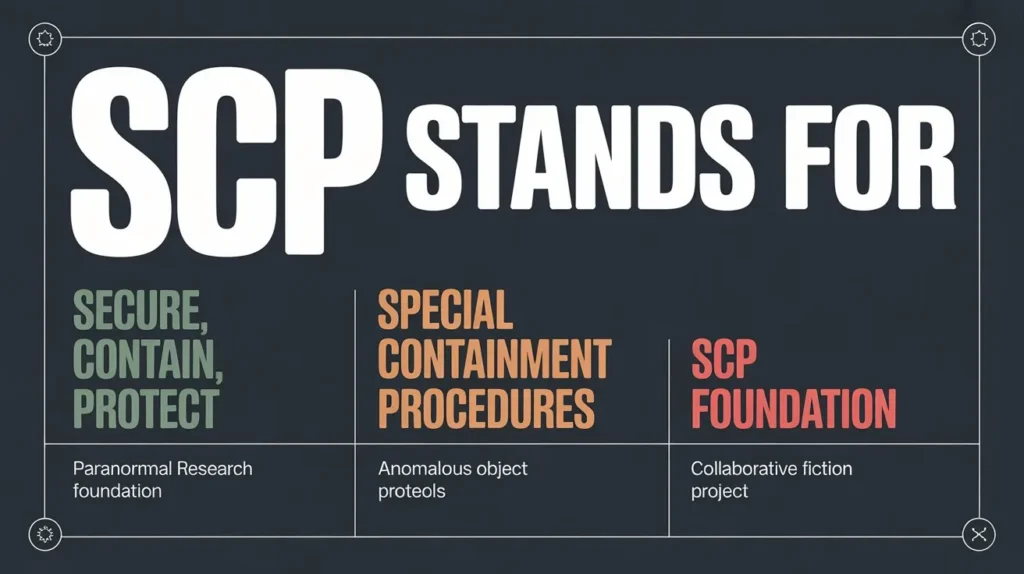

If you’ve come across the term SCP online, in a technical guide, or in a business discussion, you might be wondering: what does SCP stand for?
The answer isn’t as simple as one definition. SCP is an abbreviation with multiple meanings, and its interpretation depends entirely on the context in which it is used.
For some people, SCP refers to the popular SCP Foundation, a fictional organization known for documenting mysterious and paranormal entities.
In the world of technology, SCP commonly stands for Secure Copy Protocol, a method used to transfer files securely between systems. Meanwhile, in business and logistics, SCP can mean Supply Chain Planning, an essential part of modern operations management.
In this article, we’ll explore all major meanings of SCP, explain where each one is used, and help you clearly understand which definition applies in different situations.
What Does SCP Stand For? (Quick Answer)
The abbreviation SCP can stand for several different terms, depending on the field or context in which it is used. This is why many people feel confused when they encounter the term for the first time. Unlike acronyms with only one definition, SCP has multiple widely accepted meanings across industries such as internet culture, technology, and business.
Most commonly, SCP stands for:
- Special Containment Procedures – A term used in the fictional SCP Foundation, referring to methods designed to contain anomalous or supernatural entities.
- Secure Copy Protocol – A technology term used in computing and cybersecurity to describe a secure method of transferring files between systems.
- Supply Chain Planning – A business and logistics term focused on managing production, inventory, and distribution efficiently.
- Statistical Process Control – A quality control method used in manufacturing and data analysis.
Among these, Special Containment Procedures and Secure Copy Protocol are the most widely recognized meanings, especially online. The SCP Foundation has gained massive popularity through stories, games, and online communities, while Secure Copy Protocol is commonly used by system administrators and developers.
To determine which SCP meaning applies, it’s important to look at the context. If SCP appears in a horror story, game, or wiki, it usually refers to the SCP Foundation. If it’s mentioned in a Linux command, server guide, or cybersecurity article, it almost certainly means Secure Copy Protocol. Business reports and logistics discussions typically use SCP to mean Supply Chain Planning.
The sections below explore each meaning in detail to help you fully understand how SCP is used in different fields.
SCP Meaning in Internet Culture: SCP Foundation
In internet culture, SCP most commonly stands for Special Containment Procedures. This meaning comes from the SCP Foundation, a collaborative fictional universe that focuses on documenting and containing mysterious, supernatural, and unexplained entities known as SCPs. Each SCP is described in a formal report-style format, making the stories feel realistic and immersive.
The SCP Foundation is presented as a secret organization tasked with protecting humanity by securing and studying dangerous anomalies. Every SCP entry includes details such as containment methods, potential risks, and scientific observations. This unique storytelling style has helped the SCP Foundation gain a massive online following.
One reason the SCP Foundation is so popular is its open-contribution model. Writers from around the world can submit their own SCP entries, expanding the universe continuously. These stories range from terrifying horror concepts to emotional and philosophical narratives, appealing to a wide audience.
SCP objects are classified based on how difficult they are to contain. Common classifications include Safe, Euclid, and Keter, each indicating the level of threat and unpredictability. These classifications have become widely recognized terms within the SCP community.
Many people encounter SCP through YouTube videos, games, forums, and social media, which often present SCP stories in documentary-style formats. This presentation sometimes causes confusion, leading newcomers to wonder whether the SCP Foundation is real.
In reality, the SCP Foundation is entirely fictional. However, its detailed writing and scientific tone make it one of the most convincing and influential horror fiction projects on the internet, explaining why the term SCP is so widely recognized today.
SCP in Cybersecurity and Computing
In the field of technology, SCP stands for Secure Copy Protocol. This meaning of SCP is completely unrelated to internet horror stories and instead plays an important role in cybersecurity and system administration. Secure Copy Protocol is a network protocol used to transfer files securely between computers over a trusted connection.
SCP works by using SSH (Secure Shell) to encrypt both the data being transferred and the authentication process. This encryption helps protect sensitive files from being intercepted by unauthorized users. Because of this built-in security, SCP is widely used by developers, IT professionals, and system administrators.
One of the most common uses of SCP is transferring files between a local machine and a remote server. It is especially popular in Linux and Unix-based systems, where SCP can be executed through the command line. Users often rely on SCP to upload configuration files, download backups, or move data between servers in a secure way.
Compared to older file transfer methods like FTP, SCP offers a much higher level of security. While FTP sends data in plain text, SCP encrypts all transmissions, making it safer for modern computing environments. However, SCP is generally more basic than alternatives like SFTP, as it lacks advanced file management features.
Despite its limitations, Secure Copy Protocol remains widely used because of its simplicity, reliability, and strong security. When SCP appears in technical documentation, Linux tutorials, or cybersecurity guides, it almost always refers to Secure Copy Protocol rather than any fictional or business-related meaning.
SCP in Business and Supply Chain Management
In business and logistics, SCP stands for Supply Chain Planning. This meaning of SCP focuses on the strategic process of organizing how products are manufactured, stored, and delivered to customers. Supply Chain Planning plays a critical role in helping companies operate efficiently while meeting customer demand.
Supply Chain Planning involves analyzing data related to demand forecasting, inventory levels, production schedules, and distribution networks. By planning these elements in advance, businesses can reduce waste, avoid shortages, and respond more effectively to market changes. SCP is especially important in industries such as manufacturing, retail, and e-commerce, where timing and accuracy are essential.
One of the main goals of SCP is to balance supply and demand. Companies use planning tools and software to predict future needs and adjust production accordingly. This helps prevent overproduction, which increases storage costs, and underproduction, which can lead to lost sales and unhappy customers.
SCP also helps businesses manage risks within the supply chain. Factors such as supplier delays, transportation issues, and sudden demand spikes can disrupt operations. Effective supply chain planning allows organizations to prepare contingency plans and maintain continuity.
Unlike the fictional or technical meanings of SCP, Supply Chain Planning is a real-world business function used by organizations worldwide. When SCP is mentioned in business reports, logistics discussions, or enterprise software solutions, it almost always refers to Supply Chain Planning and not Secure Copy Protocol or the SCP Foundation.
Understanding this context is key to correctly interpreting what SCP stands for in professional environments.
Other Meanings of SCP Across Different Fields
Beyond internet culture, technology, and business, SCP can stand for several other terms depending on the academic or professional field. Although these meanings are less commonly searched, they are still important for a complete understanding of the abbreviation.
In statistics and quality management, SCP often refers to Statistical Process Control. This is a method used to monitor and control processes through data analysis. Statistical Process Control helps organizations ensure that manufacturing or service processes remain stable and operate efficiently. By using control charts and performance metrics, companies can identify defects, variations, and inefficiencies early.
In scientific and medical contexts, SCP may appear as an abbreviation for specialized programs, procedures, or proteins, depending on the discipline. These meanings are usually highly technical and are typically understood only within a specific professional community. Because of this, context is essential when encountering SCP in academic papers or research materials.
SCP can also be used in education and examinations as an acronym for program names, certifications, or institutional terms. These usages are often region-specific and may not apply universally.
Since SCP has so many possible interpretations, misunderstandings are common. Many people assume SCP always refers to the SCP Foundation or Secure Copy Protocol, but this is not always the case. The surrounding content—such as whether the topic involves data analysis, healthcare, or education—provides valuable clues.
By recognizing these lesser-known meanings, readers can better interpret SCP when it appears outside its most popular contexts, ensuring clearer communication and fewer misconceptions.
How to Know Which SCP Meaning Applies
Because SCP has multiple meanings, identifying the correct definition depends entirely on the context in which it is used. Understanding a few key clues can help you quickly determine what SCP stands for in any situation.
First, consider the platform or source where you encountered the term. If SCP appears in a horror story, video game, YouTube documentary, or online wiki, it almost always refers to the SCP Foundation, where SCP means Special Containment Procedures. These contexts often include fictional case files, anomaly descriptions, and containment classifications.
If SCP is mentioned in a technical guide, server tutorial, Linux command reference, or cybersecurity article, the meaning is almost certainly Secure Copy Protocol. Words like “SSH,” “file transfer,” “server,” or “command line” are strong indicators of this usage.
In business reports, logistics discussions, or enterprise software documentation, SCP usually stands for Supply Chain Planning. This context often includes terms such as inventory management, demand forecasting, production scheduling, and distribution.
Academic or industrial materials involving data analysis, quality control, or manufacturing may use SCP to refer to Statistical Process Control. Charts, performance metrics, and process optimization are common clues here.
Another helpful method is to look at how SCP is written. Technical SCP is often shown in lowercase as a command (scp), while the SCP Foundation is written in uppercase and discussed as a noun. By analyzing the surrounding language and subject matter, you can accurately determine which SCP meaning applies and avoid confusion.
Common Misconceptions About SCP
Due to its widespread use across different fields, SCP is often misunderstood. One of the most common misconceptions is that SCP has only one meaning. In reality, SCP is a multi-purpose abbreviation used in fiction, technology, business, and academia, which is why confusion frequently occurs.
Another popular misconception is that the SCP Foundation is real. Because SCP Foundation entries are written in a scientific, official tone and presented as classified documents, many first-time readers believe they are based on true events. However, the SCP Foundation is entirely fictional, created as a collaborative writing project for entertainment purposes.
Some people also assume that SCP always refers to Secure Copy Protocol. While this is true in technical environments, it is not accurate in online communities, gaming, or storytelling contexts. Likewise, business professionals may mistakenly think SCP relates to technology when, in their field, it clearly stands for Supply Chain Planning.
Another misunderstanding is that SCP is dangerous or illegal. This belief usually comes from SCP Foundation stories, which describe dangerous anomalies and strict containment measures. In real-world usage, SCP as a protocol or business term has no harmful or illegal implications.
Lastly, many believe SCP is too complex to understand. In reality, once the context is clear, SCP meanings are straightforward. Whether it refers to a fictional organization, a secure file transfer method, or a planning process, SCP is easy to interpret when used correctly.
Understanding these misconceptions helps readers confidently identify what SCP stands for without confusion or false assumptions.
FAQ:
What does SCP stand for in simple terms?
SCP stands for different things depending on the context. In simple terms, it most commonly means Special Containment Procedures, Secure Copy Protocol, or Supply Chain Planning.
What is SCP best known for?
SCP is best known for the SCP Foundation, a popular fictional universe featuring mysterious and supernatural entities documented in a scientific style. This version of SCP is especially popular online.
Is the SCP Foundation real or fictional?
The SCP Foundation is completely fictional. It is a collaborative storytelling project created by online writers. Although it feels realistic, none of the SCP entities or containment procedures exist in real life.
What does SCP mean in Linux or computing?
In Linux and computing, SCP stands for Secure Copy Protocol. It is used to securely transfer files between computers using encryption through SSH.
What does SCP stand for in business?
In business, SCP means Supply Chain Planning. It refers to planning and managing production, inventory, and distribution to meet customer demand efficiently.
Why does SCP have so many meanings?
Many abbreviations are reused across industries. SCP developed separate meanings in fiction, technology, and business over time, leading to multiple valid interpretations.
How do I know which SCP meaning is correct?
You can determine the correct meaning by looking at the context, such as whether the topic involves horror stories, servers and file transfers, or logistics and operations.
Final Summary:
So, what does SCP stand for? The answer depends entirely on where and how the term is used. Unlike abbreviations with a single definition, SCP has multiple meanings across different industries, which explains why it often causes confusion.
In internet culture, SCP most commonly means Special Containment Procedures, a term popularized by the fictional SCP Foundation. This version of SCP is known for its detailed storytelling, mysterious anomalies, and strong online presence through games, videos, and forums.
In technology and cybersecurity, SCP refers to Secure Copy Protocol, a practical and secure method for transferring files between computers using encryption. This meaning is widely used by IT professionals, developers, and system administrators.
In business and logistics, SCP stands for Supply Chain Planning, a real-world process that helps organizations manage inventory, production, and distribution efficiently. This usage is common in corporate environments and enterprise software systems.
There are also lesser-known meanings of SCP in statistics, education, and scientific fields, further reinforcing the importance of context. By paying attention to surrounding keywords, subject matter, and usage environment, you can quickly determine which SCP definition applies.
Ultimately, SCP is a versatile acronym with both fictional and real-world significance. Understanding its different meanings allows you to interpret the term accurately and confidently, no matter where you encounter it.