
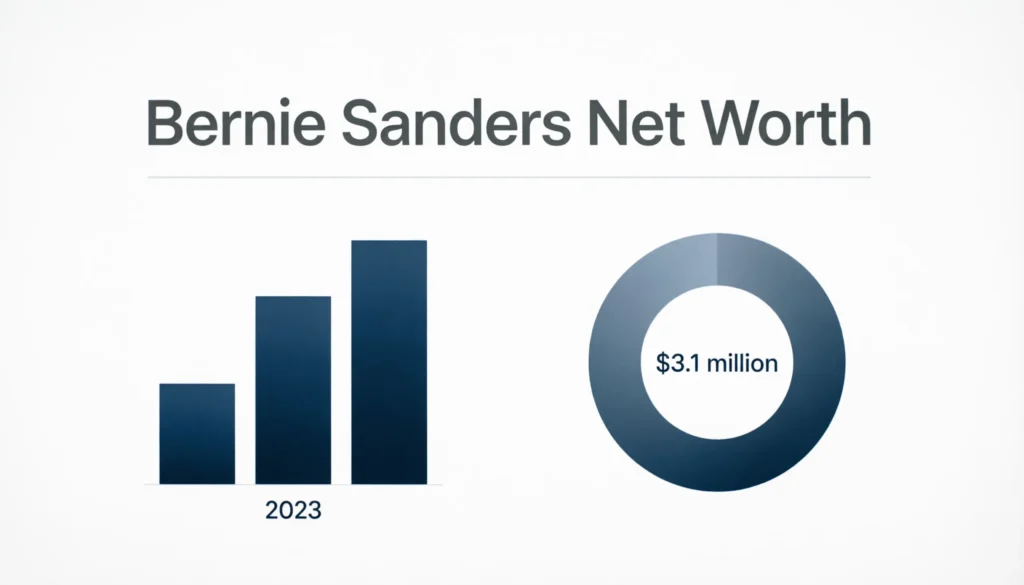
When it comes to American politics, few names spark as much debate as Bernie Sanders. Known as the “millionaire socialist,” Sanders has been a leading voice for progressive policies in the U.S., yet many people are curious about his personal finances.
How much is Bernie Sanders really worth? What are the sources of his income, and how has his wealth evolved over the years?
Despite championing income equality, Sanders himself has accumulated a notable net worth through decades of public service, book deals, and speaking engagements.
From his early career as a teacher and community organizer to becoming a U.S. Senator and presidential candidate, Sanders’ financial journey reflects both his modest lifestyle and the perks of political life.
In this article, we’ll break down Bernie Sanders’ net worth in 2026, explore his income sources, assets, and lifestyle, and compare his wealth with other politicians to reveal the full picture behind the headlines.
Bernie Sanders Net Worth in 2026
As of 2026, Bernie Sanders is estimated to have a net worth of $3 million to $4 million. While this is far below the billionaire level of some politicians, it still places Sanders comfortably in the millionaire category. His wealth comes primarily from his long political career, book royalties, and occasional paid speaking engagements.
Sanders has served as the Mayor of Burlington, a U.S. Congressman, and a U.S. Senator, earning a steady salary over decades. In addition, his bestselling books, including Our Revolution and Where We Go From Here, have added significantly to his income, generating hundreds of thousands in royalties.
Unlike many politicians who invest heavily or inherit wealth, Sanders’ financial growth has been relatively modest. He is known for his frugal lifestyle, modest home, and cautious spending habits. Public financial disclosures show that he owns a home in Vermont and another in Washington, D.C., along with retirement accounts and investments typical for someone in his position.
Overall, Bernie Sanders’ net worth in 2026 reflects a lifetime of public service combined with careful financial management, offering a clear picture of a millionaire who lives close to his means.
Bernie Sanders Net Worth Over Time
Bernie Sanders’ financial journey reflects decades of public service, modest living, and careful financial planning. In his early years, before entering politics, Sanders worked as a teacher and community organizer, earning a relatively low income. During this period, his net worth was minimal, mainly limited to savings from his teaching salary and small investments.
By the time he became the Mayor of Burlington in the 1980s, Sanders began to establish a stable financial footing, though his net worth remained modest compared to most politicians. Serving in the U.S. House of Representatives from 1991 to 2007, he earned a steady congressional salary, which helped him gradually increase his assets.
Sanders’ net worth saw a more significant boost during and after his tenure as a U.S. Senator beginning in 2007, as well as from his bestselling books such as Our Revolution and Where We Go From Here. Speaking engagements and media appearances added to this growth.
Today, Sanders’ net worth is estimated between $3 million and $4 million. Unlike many wealthy politicians, his financial growth has been gradual, reflecting a lifetime of service, frugal choices, and income primarily from salary, royalties, and modest investments, rather than inherited or speculative wealth.
Main Sources of Bernie Sanders’ Income
Bernie Sanders’ wealth comes from several key sources, each contributing to his net worth in 2026. The largest and most consistent source is his Senate salary. As a U.S. Senator, Sanders earns an annual salary of $174,000, which has steadily increased over his decades-long political career. Prior to this, his congressional and mayoral salaries provided a solid financial foundation.
Another significant source of income comes from book royalties. Sanders is the author of multiple bestselling books, including Our Revolution and Where We Go From Here. These publications have earned him hundreds of thousands of dollars in royalties, further boosting his financial profile.
Additionally, Sanders occasionally earns money through paid speaking engagements and public appearances, though he is selective and not known for large-scale commercial speaking tours.
Finally, Sanders’ investments and retirement accounts add modestly to his wealth. While he does not have the extensive investment portfolios of some wealthy politicians, his savings, mutual funds, and retirement contributions reflect careful financial management over time.
Overall, Bernie Sanders’ income is a mix of public service salary, book earnings, and modest investments, showing a gradual and responsible accumulation of wealth rather than rapid or inherited riches. This diversified approach has enabled him to maintain financial stability while living relatively modestly.
Bernie Sanders Assets & Lifestyle
Despite being a millionaire, Bernie Sanders is known for his modest lifestyle and careful financial management. His primary assets include his home in Burlington, Vermont, where he has lived for decades, and a residence in Washington, D.C., close to the U.S. Capitol. These properties reflect practical choices rather than extravagant spending.
Unlike many politicians, Sanders avoids flashy displays of wealth. He drives modest vehicles and does not own luxury cars or yachts. His spending habits emphasize simplicity, consistent with his public image as a progressive advocating for income equality.
In addition to real estate, Sanders holds retirement accounts and modest investments, including mutual funds and government securities. Public financial disclosures show no evidence of speculative investments or high-risk financial ventures.
Sanders’ frugal approach extends to daily life. He is known to lead a simple lifestyle, prioritizing public service and community over personal luxury. This careful approach allows him to maintain a solid financial foundation while avoiding the extreme accumulation of wealth seen among some of his peers in politics.
Overall, Bernie Sanders’ assets and lifestyle demonstrate that being a millionaire does not necessarily mean living extravagantly, aligning his wealth with the values he has promoted throughout his political career.
Is Bernie Sanders Really Rich? Comparison with Other Politicians
While Bernie Sanders is technically a millionaire, his wealth is modest compared to many other U.S. politicians. With a net worth of $3 million to $4 million, Sanders has more financial stability than the average American, but he is far from the billionaire status of some prominent political figures.
For context, politicians like Mitt Romney or Nancy Pelosi have net worths exceeding hundreds of millions, largely due to investments, business ventures, and inheritance. Compared to them, Sanders’ wealth is the result of decades of public service, book royalties, and modest investments. He does not rely on inherited wealth or extensive financial portfolios to maintain his lifestyle.
Sanders’ financial situation is also unique given his political stance. As a leading progressive voice, he advocates for income equality and higher taxes on the wealthy. His net worth, therefore, often draws public attention and criticism, especially from those highlighting the “millionaire socialist” narrative.
In reality, Sanders’ wealth reflects a lifetime of service combined with responsible financial planning. He earns comfortably, owns property, and maintains savings, but his lifestyle remains grounded and far less extravagant than many of his colleagues in Congress or other high-profile politicians.
Controversies About Bernie Sanders’ Wealth
Bernie Sanders’ net worth has often been at the center of public debate, largely due to the so-called “millionaire socialist” controversy. Critics argue that Sanders’ financial status seems at odds with his long-standing advocacy for wealth redistribution and progressive taxation policies. Headlines frequently highlight the irony of a millionaire campaigning for higher taxes on the wealthy, fueling debates across media outlets.
Despite these criticisms, Sanders has addressed the controversy directly, emphasizing that his wealth comes from decades of public service, book royalties, and modest investments rather than inheritance or corporate ventures. Unlike many politicians, he does not engage in high-risk investments or luxury spending, which supports his narrative of living within his means.
The debate also touches on broader issues in American politics, such as how politicians earn and report income. Financial disclosures show that Sanders’ earnings are transparent, with most of his wealth tied to salary, property, and book deals.
Ultimately, the controversy reflects a mix of perception and reality. While Sanders is technically a millionaire, his frugal lifestyle and careful financial choices align with the progressive values he has promoted throughout his career, challenging critics who paint him as disconnected from his political principles.
(FAQs)
1. What is Bernie Sanders’ net worth in 2026?
Bernie Sanders’ net worth in 2026 is estimated between $3 million and $4 million, primarily from his Senate salary, book royalties, and modest investments.
2. Is Bernie Sanders a millionaire?
Yes, Sanders qualifies as a millionaire. Unlike many politicians, his wealth comes largely from decades of public service and book deals.
3. How does Bernie Sanders make money?
Sanders earns income through his U.S. Senate salary, royalties from bestselling books, occasional paid speaking engagements, and retirement accounts.
4. What are Bernie Sanders’ main assets?
His main assets include his home in Burlington, Vermont, a residence in Washington, D.C., retirement accounts, and modest investments.
5. How does Bernie Sanders compare to other politicians in wealth?
Compared to wealthier politicians like Mitt Romney or Nancy Pelosi, Sanders’ wealth is modest. He emphasizes a simple lifestyle and careful financial management, reflecting his progressive principles.
6. Did Bernie Sanders inherit his wealth?
No, Sanders built his net worth over decades of work in politics, activism, and writing, with little reliance on inheritance or business ventures.
Conclusion
Bernie Sanders’ net worth in 2026 paints a picture of a millionaire who has achieved financial stability through decades of public service, writing, and prudent money management. While his wealth is modest compared to some of the richest politicians, it reflects a combination of steady salaries, book royalties, and responsible investments.
What sets Sanders apart is his frugal lifestyle and transparency, which align with the progressive values he has championed throughout his career. He owns properties in Vermont and Washington, D.C., maintains retirement accounts, and avoids the extravagant spending habits common among high-profile politicians.
The so-called “millionaire socialist” controversy often brings his wealth under scrutiny, but the reality is that Sanders’ financial growth has been gradual and earned primarily through his own work rather than inheritance or speculative ventures. His income sources—salary, books, and modest investments—demonstrate a disciplined and careful approach to wealth accumulation.
Overall, Bernie Sanders’ net worth is a reflection of responsible financial planning, career longevity, and principled living. For readers curious about the financial side of politics, his story offers a clear example of how wealth can coexist with public service and progressive ideals.